



Mirrors are the one bathroom decision people agonise over for a week and then regret going small on.
Part of the problem is that the internet gives you a percentage rule and stops there, which is no help when the mirror you want only comes in two sizes and neither matches the maths. So here is the rule, when to break it, and the sizes that actually exist so you can stop measuring in the abstract.
The Rule, And What It Is Actually For
Start with the vanity, always. The mirror is sized off the thing underneath it.
The usual guidance is that a bathroom mirror should not be wider than the vanity, and for a round mirror most sources land somewhere around 70 to 80 percent of the vanity width. That percentage varies between sources, which tells you something useful. It is a starting point, not a law.
A glazier put it more usefully. Match the vanity width, then set the height to the tile line or to match the head of the shower or door frame. That second half is the bit the percentage rule leaves out, and it is what makes a bathroom look designed rather than assembled.
[collection-carousel="mirrors"]
The Sizes That Actually Exist
Mirrors come in shapes, and each shape has its own size ladder. Knowing them saves you fighting a percentage into a size nobody makes.
|
Shape |
Common sizes |
Pairs well with |
|---|---|---|
|
Round |
600, 700, 750, 800, 900 and 1000 mm diameter |
600 to 1200 mm vanities, single basin |
|
Rectangular or soft square |
750 by 600, 900 by 700, 1200 by 750, 1500 by 750, 1800 by 850 mm |
Any vanity. The most flexible option. |
|
Arch |
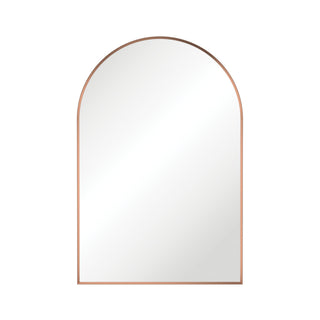
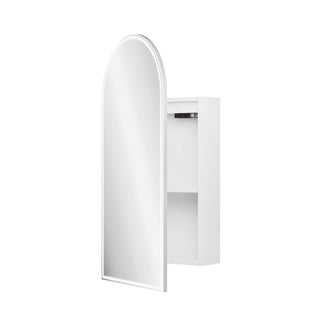
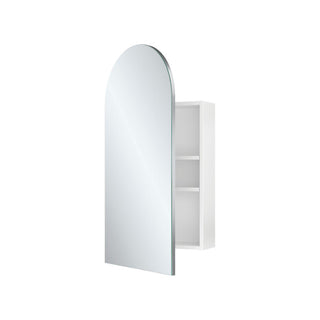
500, 600, 750 and 900 mm wide, plus 550 by 900 and 1100 by 900 mm |
600 to 900 mm vanities where you want height |
|
Pill or oval |
450 by 900 and 1200 by 550 mm, plus 450 to 750 mm widths |
Narrow walls, or wide low walls under a window |
|
Tall portrait |
400 by 900, 600 by 1200, 900 by 1200 mm |
Small bathrooms where wall height beats wall width |
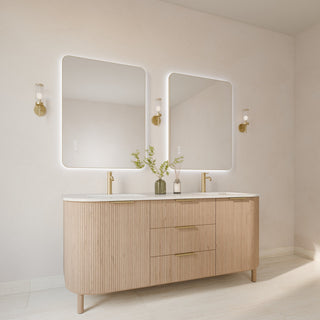
The easy matches are the obvious ones. A 900 mm vanity takes a 900 mm round or a 900 by 700 rectangle. A 1200 mm vanity takes a 1200 by 750. A 600 mm ensuite vanity takes a 600 round or a 600 by 750 portrait.
[collection-carousel="basins"]
When To Break The Rule And Go Bigger
Here is the thing the percentage rule gets wrong in small bathrooms.
One renovator fitted a 1100 mm round mirror over a 900 mm vanity and rates it as the best decision in the room. That is well over 100 percent of the vanity width and it works, because in a tight bathroom the mirror is doing two jobs at once. It shows you your face and it doubles the apparent size of the room.
A mirror reflects both daylight and artificial light back into the space, which is why designers reach for larger mirrors in small rooms rather than smaller ones. In an average Adelaide bathroom with one window and one ceiling light, that effect is worth more than perfect proportion.
The Honest Version Of The Rule
So the honest version of the rule is this. Match the vanity if the bathroom is generous. Go wider than the vanity if the bathroom is small and the wall allows it. What you should not do is go narrow, because a small mirror on a big wall makes the whole room look like an afterthought.
[collection-carousel="tapware"]
Getting The Height Right
Width gets all the attention and height is what you notice while using it.
Three practical anchors. Leave roughly 100 to 200 mm between the vanity top and the bottom edge of the mirror, so you can still use the bench without knocking into glass. Set the top edge level with either the tile line, the head of the shower screen, or the top of the door frame, whichever line already exists in the room. And check the sightline for the shortest and tallest people in the house before it goes up.
If you have a counter top basin, remember it eats into that gap. A tall vessel basin plus a mirror set at the usual height can leave almost no clearance, so measure from the top of the basin rather than the top of the bench.
Round Or Rectangular
A round frameless mirror is the forgiving choice here, because a circle has no top edge to align and it does not look wrong if the room's lines are slightly off. A rectangular frameless mirror is the opposite, which is exactly why it looks so sharp when you get it right.
[collection-carousel="accessories"]
Why Cheap Mirrors Go Black At The Edges
This is worth more of your attention than the size question, honestly.
Bathroom mirrors fail from the outside in. Moisture works its way under the reflective backing at the cut edge and corrodes it, which shows up first as dark spotting or a cloudy border and then spreads inward. Once it starts you cannot fix it. You replace the mirror.
The defence is edge sealing. A mirror cut and finished properly for a wet area normally has a sealant applied to the edges, and a glazier making one to measure will do this as standard. A bargain mirror with a raw cut edge in a bathroom that gets steamy twice a day is on a clock.
How To Slow It Down
Two things extend the life of any mirror. Keep the edges out of direct spray, and get the moisture out of the room. The National Construction Code requires bathrooms to be ventilated, either naturally through an opening or by mechanical exhaust, and there are separate condensation management provisions as well. A fan that actually runs long enough to clear the steam protects the mirror, the paint and the cabinetry all at once.
[collection-carousel="trade"]
Fixing, Weight And Safety
A large mirror is a heavy sheet of glass on a wall above a hard floor, so this part is not optional.
AS 1288 is the Australian Standard for the selection and installation of glass in buildings, and it covers mirrors fixed to walls as well as windows and screens, including how they are adhered or backed so a failure cannot send glass into the room.
In practice, the bigger the mirror the more it wants to be fixed into studs or into noggings added behind the plasterboard, not hung on plasterboard anchors. As with every other bathroom fitting, that backing has to go in before the wall is lined, so nominate your mirror size early rather than at the end.
[collection-carousel="towel-rail"]
LED And Demisting Mirrors
Worth considering, with one condition attached.
An LED backlit mirror solves the most common bathroom lighting problem, which is a downlight behind you throwing your own shadow onto your face. Demisting pads solve the other one, which is a mirror that is useless for the first five minutes after a shower.
The condition is that both are electrical equipment. AS/NZS 3000 divides bathrooms into zones that restrict where electrical items can sit relative to the bath and shower, and electrical work in South Australia has to be done by a licensed electrical worker. So decide on a powered mirror before the rough in, while running the cable is a five minute job rather than a wall repair.
[collection-carousel="outlets"]
The Short Version
-
Size the mirror off the vanity, not off the wall.
-
The usual guidance is no wider than the vanity, and around 70 to 80 percent for a round mirror.
-
That percentage varies between sources, so treat it as a starting point.
-
Set the top edge to the tile line, the shower screen head or the door frame.
-
Round mirrors run 600 to 1000 mm. Rectangles run 750 by 600 up to 1800 by 850 mm.
-
In a small bathroom, going wider than the vanity often looks better than matching it.
-
Never go narrow. A small mirror on a big wall looks unfinished.
-
Leave 100 to 200 mm between the bench and the bottom edge.
-
Measure from the top of a counter top basin, not the bench.
-
Mirrors fail by corrosion starting at the cut edge, and it cannot be repaired.
-
Buy a mirror with sealed edges and keep the edges out of the spray.
-
Ventilation protects the mirror. The building code requires it for a reason.
-
AS 1288 covers glass and mirrors fixed to walls.
-
Fix large mirrors into studs or added noggings, not plasterboard anchors.
-
LED and demisting mirrors are electrical work and must be planned before the rough in.
If you want a single piece of advice, it is this. Cut a piece of cardboard to the size you are considering, tape it on the wall, and look at it for a day. Nobody has ever done that and then chosen the smaller mirror.
The full mirror range lists shapes and sizes together, which makes it much easier to see which ladder your vanity width lands on.
[collection-carousel="toilets"]