






Short answer, usually yes. It is one of the few bathroom upgrades that genuinely can be done without opening a wall or lifting a tile.
But there is one detail that decides the whole job, and if you get it wrong the new vanity arrives and simply will not connect. Here is what to check before you buy, where a straight swap works, and where it quietly turns into a renovation.
The One Thing That Decides It
Look under your existing vanity and find where the waste pipe goes.
If it disappears down through the floor, you have an S trap. If it runs horizontally into the wall, you have a P trap. Those two arrangements are not interchangeable, because the fixture is set out around where its outlet has to land. Changing from one to the other means altering the drainage itself, which is a plumber and possibly a tiler.
Match the trap type you already have and most of the difficulty disappears. The trap and waste are inexpensive parts in their own right, and a DWV S and P trap is a standard fitting, but the pipe in your floor or wall is the thing that is fixed.
Worth knowing that trap design is not arbitrary either. AS/NZS 3500.2 sets the requirements for sanitary plumbing and drainage in Australia, including the water seal a fixture trap has to hold. That seal is the only thing between your bathroom and the sewer, which is why this is not a part to improvise with.
[collection-carousel="wastes"]
The Four Measurements To Take First
Do these before you look at a single product photo. It takes ten minutes.
-
Waste position. Distance from the finished wall to the centre of the waste, and from the side wall. This is the set out, and it is the number that matters most.
-
Water inlet positions. How high the two stop taps sit off the floor and how far apart they are. New cabinets have their own internal layout and a badly placed inlet can land behind a drawer.
-
Overall width and depth. Plus the tiled area behind and beneath the existing unit.
-
What is behind and under it. Is the wall tiled full height. Is the floor tiled right through, or does the tiling stop where the old cabinet sat.
That last one catches more people than the plumbing does. Plenty of older Adelaide bathrooms were tiled around the vanity rather than under it.
[collection-carousel="basins"]
Where A Straight Swap Genuinely Works
Good news first. These situations are usually a same day job with no wall or floor work at all.
|
Scenario |
Plumbing moved |
What is involved |
|---|---|---|
|
Floor vanity to floor vanity, same width, same trap type |
None |
Disconnect, swap, reconnect, seal to the wall |
|
Same trap type, going wider |
None |
Covers the old footprint, so any untiled patch disappears |
|
Same footprint, new benchtop and basin only |
None |
New waste and tap to suit the basin you have chosen |
|
Same trap type, going narrower |
None |
Works, but may expose unfinished floor or wall either side |
|
Floor vanity to wall hung |
Usually yes |
Waste and water generally have to move into the wall |
|
S trap to P trap, or the reverse |
Yes |
Drainage alteration, likely tile removal |
The pattern is simple. Same trap, same or greater width, stays on the floor. That is the swap that does not spiral.
[collection-carousel="tapware"]
Where It Stops Being Simple
Three things turn a vanity swap into something bigger, and they are worth knowing before you commit.
Going Wall Hung
If your waste currently drops through the floor and you want a floating vanity, the pipework has to come out of the wall instead. That is a drainage alteration plus making good, so budget for a plumber and a tiler rather than an afternoon.
Tiles Coming Off
This is the expensive one. Wet areas in houses have to be waterproofed to meet the National Construction Code, and the waterproof membrane sits under the tile bed. If tiles come off and the membrane is damaged, it has to be made good before anything is retiled. Tradespeople are consistent and blunt about this being the single part of a bathroom you never skimp on, and in a bathroom that is decades old the existing membrane may be at the end of its life anyway.
Old Fittings That Do Not Cooperate
Stop taps that have not been turned in twenty years sometimes will not shut, or will not reseal once they do. It is a small job on its own and an annoying surprise mid swap. Ask your plumber to check them at the quote stage.
[collection-carousel="trade"]
What It Actually Costs In Adelaide
Useful context, because the internet will tell you a bathroom costs 40 to 50 thousand dollars and that number is doing a lot of heavy lifting.
Australian renovators put a contractor built bathroom at roughly 10 to 20 thousand dollars where the plumbing and layout are not being majorly modified, with anything past 20 described bluntly as the deluxe treatment. One Adelaide homeowner reported a current quote of 25 thousand dollars covering removal and reinstallation with plumbing, electrical, waterproofing and tiling included, with all services staying exactly where they were and the customer supplying the vanity, toilet and fittings themselves.
Note what that quote is not. It is not a vanity swap. A like for like vanity replacement that keeps the trap type and the footprint is a very small fraction of that, because you are paying for a couple of hours of plumbing rather than a full strip out.
One cost detail worth planning for. If you are changing wall mounted tapware at the same time, a plumber generally attends twice, once to rough in behind the wall and again to fit off at the end. Two visits, not one.
[collection-carousel="accessories"]
What You Buy Has To Be Certified
Not glamorous, genuinely important, and the reason to be careful with bargain imports.
Plumbing products of a type listed on the WaterMark Schedule must be WaterMark certified before they are installed in Australia. That covers the sorts of parts involved in a vanity swap, including tapware and wastes. A plumber can decline to install something that is not certified, and they would be right to.
Separately, water using products regulated under the WELS scheme must be registered and must display their water efficiency information at the point of sale. If a tap is being sold in Australia without a star rating, something is off.
[collection-carousel="toilets"]
Who Is Allowed To Do The Work
Here is where South Australia is stricter than people expect.
Plumbing work in South Australia has to be performed by a licensed and registered plumber, and it has to be certified. The state requires an electronic Certificate of Compliance for plumbing work, lodged within seven days of the work being finished, and only an appropriately licensed person can complete it.
So while disconnecting and reconnecting a vanity looks like a bucket and a shifting spanner job, the connection itself is licensed work with a paper trail. Keep the certificate. It is the document that matters if you ever sell, or if a leak turns into an insurance conversation.
If you are unsure which category your swap falls into, our team can talk it through before you order anything, and the contact page is the fastest way to get that conversation started.
[collection-carousel="mirrors"]
The Short Version
-
Yes, you can usually replace a vanity without moving plumbing.
-
Find out whether your waste goes down through the floor or out through the wall.
-
Down through the floor is an S trap. Out through the wall is a P trap.
-
The two are not interchangeable without altering the drainage.
-
Measure the waste set out, the water inlet positions, the width and the depth.
-
Check whether the floor and wall are tiled behind and under the old unit.
-
Same trap type, same or greater width, staying on the floor is the clean swap.
-
Going wall hung usually means relocating the waste into the wall.
-
Going narrower can expose untiled floor either side.
-
If tiles come off and the membrane is damaged, waterproofing has to be made good.
-
Have your plumber check the old stop taps before the day.
-
A full bathroom with services staying put runs around 10 to 20 thousand dollars, with a 25 thousand dollar Adelaide quote reported for a complete strip and reinstall where the customer supplies the fittings.
-
A like for like vanity swap costs a small fraction of that.
-
Changing wall tapware usually means two plumber visits.
-
Parts must be WaterMark certified and tapware must carry a WELS rating.
-
In South Australia the work must be done by a licensed plumber and certified with an eCoC within seven days.
Do the trap check first. Everything else about this job follows from that one look under the cabinet.
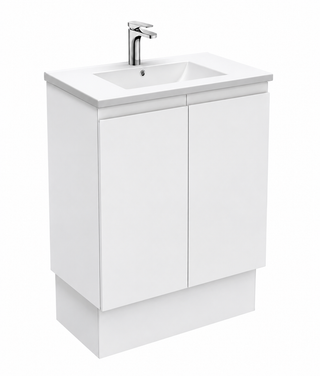
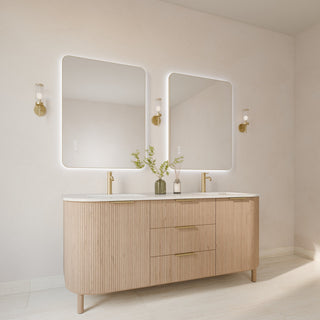
Once you know your set out, the vanity unit range lists widths and configurations so you can match what you already have, and the wastes range covers the trap and waste to suit.
[collection-carousel="kitchen-laundry"]